
Structuring Digital Knowledge
Creating knowledge graphs centred around mechanistic toxicology and AOPs, to define problem spaces and contextualise NAM evidence.
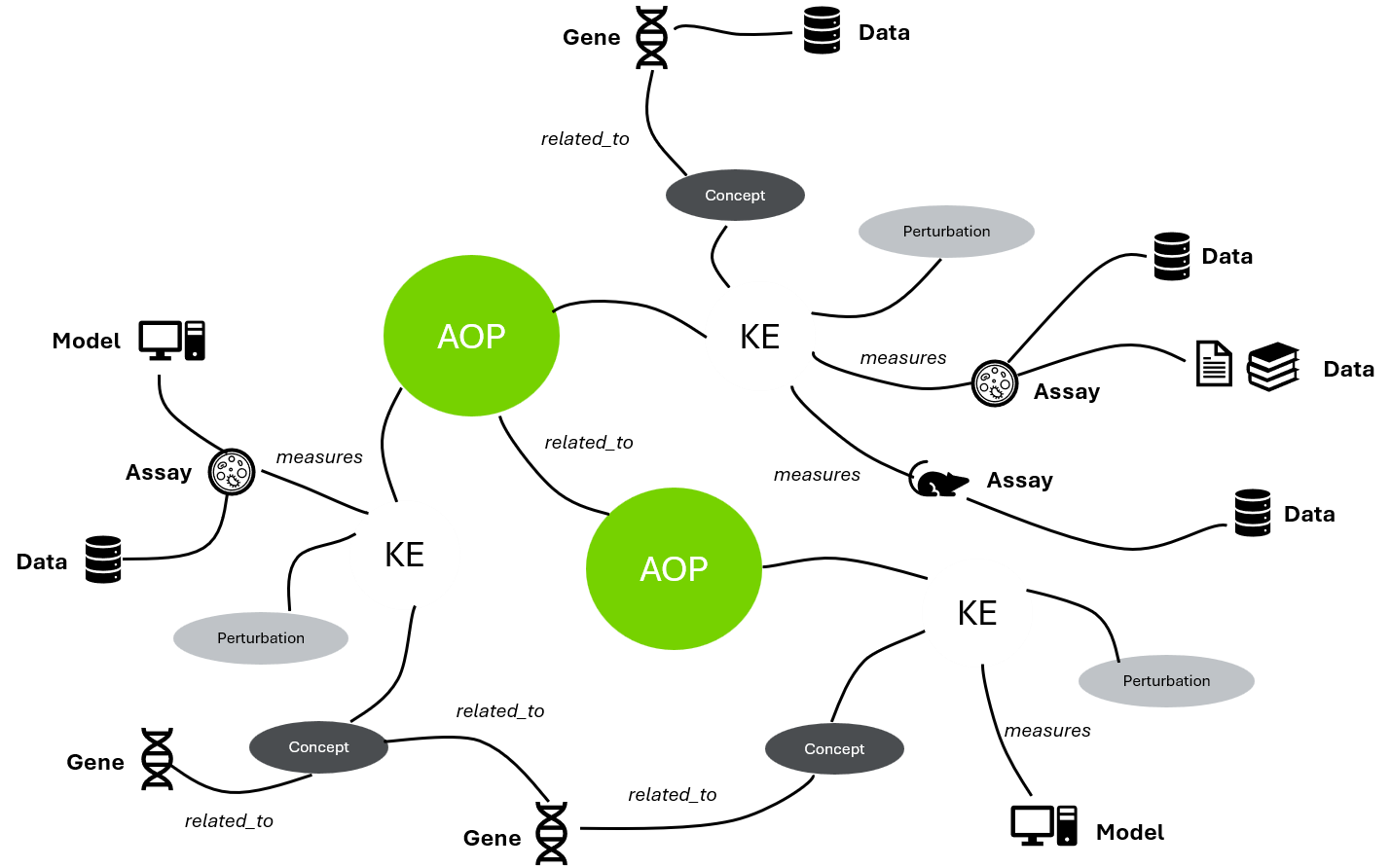
Carrying out successful weight of evidence assessments using new approach methods (NAMs) requires a clear understanding of the toxicity space under evaluation: what evidence is needed, how it should be combined, and what constitutes a confident safety decision. In some emerging testing paradigms these requirements are well defined — but for many, there is ambiguity. A framework that contextualises data, identifies gaps and conflicts, and surfaces next steps is essential.
At ToxComponents we believe mechanistic toxicology and AOP networks, combined with regulatory guidance, are the ideal tools to define this problem space and provide context to NAM data.
We are experts in developing and encoding these knowledge resources. Using AI-assisted workflows we build AOP networks that serve as reusable scientific components, anchoring next-generation toxicity assessments across multiple domains. Each problem is unique, and we bring the experience to design the right knowledge resources for your specific safety question.
Building AOP networks
From building individual bespoke AOPs linking specific proprietary protein targets to adverse events, to generating and consolidating whole networks based on public data and knowledge, our team has the relevant experience and tools to develop these knowledge resources.
Using AI assisted workflows we build coherent AOPs and AOP networks in digital formats which can be visualised and seamlessly integrated with other knowledge resources.
If you are looking to build mechanistic knowledge resources to help make decisions in your problem space please get in touch and let's discover how we can help join the dots.
Contextualising relevant evidence
AOP networks in isolation can be somewhat of an academic construct if not combined with evidence coming from the NAMs used to measure the Key Events in them.
At ToxComponents we are developing methods to meaningfully associate different disparate evidence types to relevant KEs within our mechanistic framework — from observations from traditional repeated dose studies, to model predictions built from in vitro data, to high-content outputs such as gene expression changes from transcriptomics studies. We are researching flexible methods to incorporate the outputs from these emerging technologies in meaningful ways.
If you are looking for an approach to integrating the outputs from new technologies being developed in your lab, or you would like to include historical data in your assessments, we would love to work with you to develop the methods which can automatically integrate this evidence into your weight of evidence in a meaningful way.
References
Cayley AN et al. Development of a network of carcinogenicity adverse outcome pathways and its employment as an evidence framework for safety assessment. ALTEX. 2023;40(1):34-52. doi: 10.14573/altex.2201311. PMID: 35575642.
Brescia S et al. Risk assessment in the 21st century: where are we heading? Toxicol Res (Camb). 2023 Jan 10;12(1):1-11. doi: 10.1093/toxres/tfac087. PMID: 36866215; PMCID: PMC9972812.
Ball T et al. Beyond adverse outcome pathways: making toxicity predictions from event networks, SAR models, data and knowledge. Toxicol Res (Camb). 2021 Jan 22;10(1):102-122. doi: 10.1093/toxres/tfaa099. PMID: 33613978; PMCID: PMC7885198.
Stalford SA et al. Structuring expert review using AOPs: Enabling robust weight-of-evidence assessments for carcinogenicity under ICH S1B(R1). Computational Toxicology. 2024;31:100320. doi: 10.1016/j.comtox.2024.100320.
Stalford SA, Cayley AN, de Oliveira AAF. Employing an adverse outcome pathway framework for weight-of-evidence assessment with application to the ICH S1B guidance addendum. Regulatory Toxicology and Pharmacology. 2021;127:105071. doi: 10.1016/j.yrtph.2021.105071.
Myden A et al. A developmental and reproductive toxicity adverse outcome pathway network to support safety assessments. Computational Toxicology. 2024;31:100325. doi: 10.1016/j.comtox.2024.100325.